Mira Debuts Augmented Reality Headset for iPhone, iPad at $99
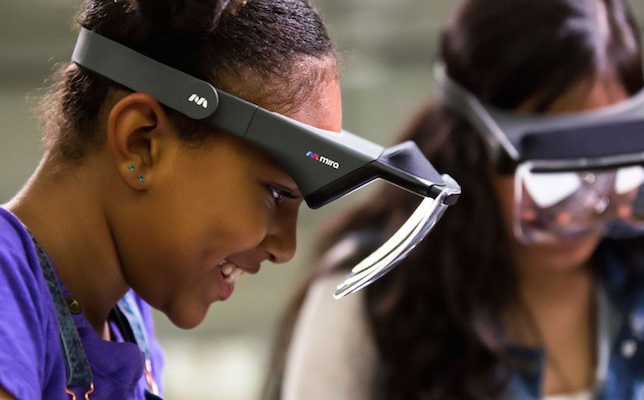
Mobile augmented reality (AR) startup Mira earlier this week unveiled an untethered AR headset for iOS.
The new Prism headset — available for pre-order at $99 with an MSRP of $149 — aims to be an affordable option “to deliver premium and shareable AR experiences to the masses,” according to a company statement.
It’s essentially a shell headset without any tech installed; similar to Google’s Daydream View headset for virtual reality, it only requires a smartphone or tablet to get started. Once an iPhone (6, 6s or 7) or iPad has been secured facing away from the user and Prism is paired with the Mira app, users can view objects rendered in stereoscopic 3D on the transparent visor. Prism also comes with a remote controller that enables users to interact with the AR objects via touchpad, trigger and two buttons.
A video demonstration (as seen above) shows how the AR headset can be utilized, with potential for the classroom. To share the experience, for instance, a “spectator mode” setting in the app allows individuals to watch their friends experience AR from their own phone or tablet in real time.
Other key features include:
- Counter-distortion rendering;
- 3-DOF (degrees of freedom) rotational tracking;
- 6-DOF optical tracking;
- Resolution of 1,334 x 750;
- Networking support; and
- The Mira Asset Pack.
In terms of content, Prism will ship with a suite of solo and collaborative AR experiences that range from “mind-bending mixed-reality puzzles, holographic chess and digital warship battles, which make gaming in AR as dynamic as it is social.” For developers, Mira has a Unity-based SDK that will be available for download in August. Since it’s compatible with iOS, the headset has already generated internet buzz that it might be an opportunity for developers to test out Apple’s ARKit toolset for creating AR experiences for iPhone and iPad.
The co-founders of Mira are college students who are part of the inaugural class at the Jimmy Iovine and Andre Young Academy for Arts, Technology and the Business of Innovation, an interdisciplinary program launched by rapper Dr. Dre (Andre Young) and music mogul Jimmy Iovine in 2014. According to a company statement, the headset, software toolkit and consumer-facing content will be developed using more than $1.5 million in seed funding from Sequoia Capital and additional investments from Salesforce CEO Mark Benioff, music artist and investor will.i.am., Troy Capital Partners, S-Cubed Capital and Jaunt VR founder Jens Christensen.
Prism is now available for pre-order at mirareality.com for $99; devices will be shipped in the fall.
About the Author
Sri Ravipati is Web producer for THE Journal and Campus Technology. She can be reached at [email protected].