Non-Profit Seeks Classrooms for Gaming Pilot

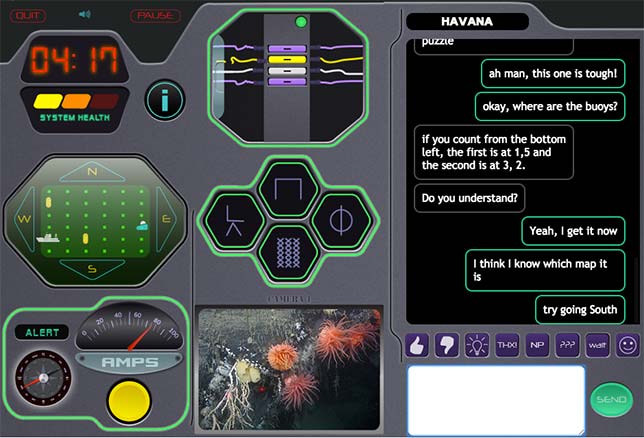
Non-profit education research group LRNG-GlassLab is seeking teachers in grades 5-11 interested in trying a follow-up to GlassLab's collaboration game, Deep Sea Crisis, as part of research project.

Non-profit education research group LRNG-GlassLab is seeking teachers in grades 5-11 interested in trying a follow-up to GlassLab's collaboration game, Deep Sea Crisis, as part of research project. The organization is a small game design group that develops education programs to help push 21st century skills in an engaging way.

Deep Sea Crisis uses gaming to entice students to work together in solving puzzles in a simulated undersea research vessel. Two players are put in charge of their own submarine, and their goal is to keep it from sinking into the depths of the ocean. While one player studies the control manual and gives instructions, the other player works the controls. The goal: to disarm all the emergency alarms before the timer expires to save the ship and keep it moving. Challenges can be set up to run for one to three 45-minute sessions. All the resources related to that game are available online with free registration.

Now, GlassLab is wrapping up development of a more difficult collaboration game, Crisis in Space!, based on the feedback it has already received from users of the sea game. The new one, which lasts about 40 minutes per session, is intended to be played by upper middle grade and high school students. The organization is seeking teachers who want to act as test pilots for the new game. Participating classrooms can learn and be part of the game development process and chat via video directly with the development team to provide feedback. To play, students will each require a computer with internet access.

The initiative is being funded by a grant from the Hewlett Foundation.

About the Author

Dian Schaffhauser is a former senior contributing editor for 1105 Media's education publications THE Journal, Campus Technology and Spaces4Learning.

Featured

  • Engineering team implements digital guardrails on AI

    3 Starting Points for Integrating AI Guardrails in K-12 Districts

    As education leaders start to craft an AI policy that is both practical and flexible enough to evolve with this fast-changing technology, there is at least one principle that should be foundational: AI should serve to augment human critical thinking and creativity but never replace human interaction and decision-making.

  • Teacher meeting parents discussing student progress in classroom

    Michigan's Flint Community Schools Adopts Human-Centered Approach to Fight Chronic Absenteeism

    In an effort to boost enrollment and combat chronic absenteeism, Michigan's Flint Community Schools has partnered with Concentric Educational Solutions to help address the academic, social, emotional, and environmental factors that prevent students from enrolling, re-enrolling, or attending school.

  • Neon blue security locks with a single red highlight

    With AI, Cybersecurity Focus Shifts from Finding Flaws to Fixing Them

    For decades, one of cybersecurity's biggest challenges has been finding vulnerabilities before attackers do. A growing number of security professionals now say artificial intelligence is changing that equation, shifting the focus from discovering flaws to fixing them quickly enough to prevent exploitation.

  • blue wooden cubes block texture abstract background

    Gartner: Worldwide IT Spending Estimated at $6.31T for 2026

    According to a Gartner forecast, worldwide IT spending will total $6.31 trillion in 2026, a 13.5% increase from 2025. Sectors experiencing the largest growth include data center systems, software, and IT services.