iCivics Updates Free Online Tool for Teaching History and Civics
- By Dian Schaffhauser
- 02/06/18
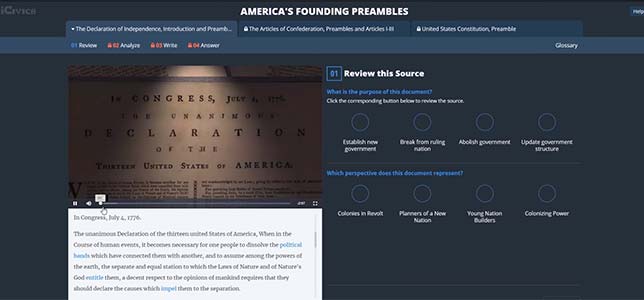
A free history and civics tool intended to help students build their understanding of civics has undergone a major update. The new version of DBQuest from iCivics was redesigned for easier sharing, use on tablets, teacher tracking of student progress and simpler addition of new teaching modules. The work was supported with a grant from the Library of Congress and relies on the use of primary sources from the library's online collections.
iCivics was founded by retired Associate Justice of the Supreme Court Sandra Day O'Connor with a goal of strengthening civic education in schools. Resources include curriculum units, lesson plans and games. The organization said its programs are used by 150,000 teachers, including more than half of American middle school social studies teachers.
DBQuest is a free online program for teaching middle school history and civics through the use of source documents, such as letters, photos, videos, interview transcripts and founding documents. Students follow an interactive, step-by-step process in which they review the primary sources, answer questions and write responses and build their arguments as a way of deepening their understanding of the topic that ties the documents together.
According to iCivics, the approach shifts the teaching of history, social studies and civics away from rote memorization and toward the use of "evidence-based reasoning and investigation of facts." Each module is intended to take no longer than two or three 45-minute class periods.
Among the updates to the platform is a design that will enable teachers to track student progress and share their work in the classroom. The new design also streamlines the process of working with new teaching modules and makes the software usable on tablet devices.
Two new modules are being introduced with the relaunch:
- In "The Nashville Sit-In Movement of 1960" students explore this "pivotal moment" in the civil rights movement by reading interview excerpts, examining a photo and watching a short video to better understand segregation, the principles of nonviolent protest and why the sit-ins were effective.
- "America's Founding Preambles" helps students understand how a confederation of states evolved into a united republic. According to the organization, the sources "will illustrate the effort taken to reach 'a more perfect union' through editorial choices between and within the founding documents."
iCivics said it would release at least two other modules over the next year, covering the Louisiana Purchase and the Constitutional Convention of 1787. It will also seek out new partners that possess "rich primary source" to create additional source material-based inquiries for students.
"Teachers constantly tell us that they need better tools for teaching with primary sources, but that they struggle to find the resources and the time to create the materials on their own," said iCivics Executive Director, Louise Dube, in a press release. "DBQuest gives them a fun and meaningful way to teach students how to analyze information and build arguments around timely, socially relevant content."
About the Author
Dian Schaffhauser is a former senior contributing editor for 1105 Media's education publications THE Journal, Campus Technology and Spaces4Learning.