Database Provides Accurate Accounting of School Shootings
- By Dian Schaffhauser
- 11/13/18
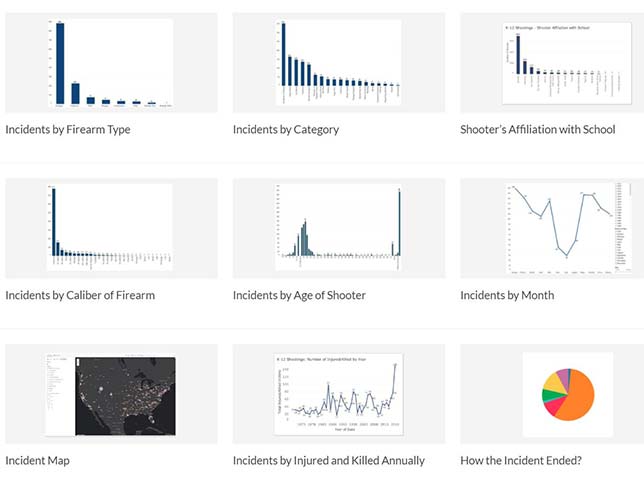
In 1970 19 separate school shootings occurred within the United States. In 2018, so far, 87 shootings have taken place. During those nearly five decades, of the shootings where the age of the shooter was known, 157 involved 17-year-olds and 147 involved 16-year-olds. Fifty-seven have involved females. A total of 716 people have been killed or died (including the shooters); another 1,459 have been wounded. California has seen the most shootings (157), followed by Texas (130). In the majority of school shootings, immediately after shots were fired, the shooter fled.
Those findings and many other aspects of school shootings make up the contents of a new, open resource developed jointly by the Center for Homeland Defense and Security and FEMA. The "K-12 School Shooting Database" provides reporting and downloadable data to document every instance a gun is brandished or fired or a bullet hits school property for any reason.
The information was culled from a multitude of sources, including 23 other databases of school shootings maintained by government agencies, media companies and other organizations, along with coverage in peer-reviewed studies, government reports, mainstream news media, non-profits, private websites, blogs and crowd-sourced lists. All of that content has been "analyzed, filtered, deconflicted and cross-referenced." Then the data was validated by obtaining police reports from the local law enforcement agency that responded to a given shooting and asking those agencies to report additional school shootings that may not have been on the original list.
The data shared in the database consists of nearly 50 details, from school type to type of weapon, from whether the shooter was bullied to whether the shooting took place during a sporting event, from the number of shots fired to the time, date, day of week and time period when it happened.
Each of the 1,322 incidents in the database has also been given a "reliability" score between 1 and 5; a low of 1 was issued to those events referenced by a single source; 5 was given to those that were vetted through court records or police reports.
The database is updated daily.
The project is conducted as part of the Advanced Thinking in Homeland Security program at the Naval Postgraduate School's Center for Homeland Defense and Security. The goal is to serve as a single source for "objective and accessible data from which school administrators, law enforcement and public officials can draw to inform their decisions," according to a report on the project.
One challenge the researchers faced was simply defining what a school shooting is. As the report explained, for example, a shooting that occurred in August 2018 outside of a football game on the property of the high school didn't involve a shooter or victims who were students. Therefore, the chief of that community's sheriff's office said the event couldn't be considered a "school shooting," even though "it caused chaos in the stands as students, parents, and visitors fled the stadium." At the same time, some incidents classified as school shootings actually occurred away from school property.
Authors Desmond O'Neill and David Riedman hope a major use for the data will be to help school administrators decide how best to protect their communities. "It's important for the stakeholders to know that half of school shootings occur outside, just based on the data that we collected. That's a part of a population that may not have been considered," said O'Neill during a YouTube interview on the project. "When you have a limited amount of money to spend on how to advance your school, it's important to understand where all the data falls. It's not just within the school building; it's also in the parking lot; in the sporting events; in the football fields. Having all of that information in front of you [lets] you make your decision in terms of what's best for your community, for your children, for your resources."
About the Author
Dian Schaffhauser is a former senior contributing editor for 1105 Media's education publications THE Journal, Campus Technology and Spaces4Learning.