Carnegie Mellon CS Academy Creating Free High School Coding Curriculum
- By Dian Schaffhauser
- 02/13/19
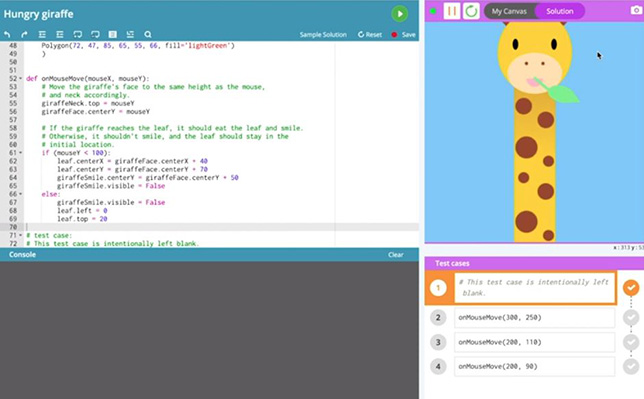
Carnegie Mellon University has launched a free, online curriculum for high school students to help instructors teach programming skills using graphics and animations. The lessons were developed by the new CMU Computer Science Academy, part of the School of Computer Science.
According to David Kosbie, an associate teaching professor and co-director, the Academy was started to address requests from secondary school teachers and principals, who wanted to fill the demand for CS education but had to cope with a lack of resources for teaching it and a shortage of trained teachers for delivering instruction.
The curriculum is targeted at ninth grade, though it's intended to bridge the plethora of introductory CS materials available for grades K-8 and the Advanced Placement courses students might tackle later in high school. The free curriculum is designed for use by classroom teachers, not as a self-guided online course.
Currently, CS1, as it's called, is being used in 40 schools; primarily in Pennsylvania, but also elsewhere. That testing has found that although the curriculum isn't easy, students in those pilot schools have had notable success, even those attending under-resourced schools. It's expected to be made widely available this fall.
"This isn't 'drag and drop' programming," said Kosbie, in a statement. "We're teaching [students] to use Python, a text-based programming language that is the most widely taught language at the university level." It's also a popular programming language, used by coders in even the largest tech companies.
One of its unique features is graphics and animation exercises for each unit that were developed by "dozens" of the university's computer science students.
"Most of the students involved in the project are just a few years older than the high school students who will be using CS1," noted Erin Cawley, project manager for the CS Academy and a former K-12 CS educator, who narrates many of the videos currently available about the curriculum. The idea, she said, was to make the exercises engaging and fresh.
"The hardest part of programming for many novices is debugging" she explained. "With graphics, it's easy for students to see what went wrong: 'Oh, the ear shouldn't be on the forehead, it should be over here.'"
The Academy insisted that the materials would be useful to teachers even if they don't have experience with CS. regardless of whether they have experience in computer science. The Academy has made teacher training and online support available for that purpose. Also, there are a number of extra features to help teachers out. For example, CS1 offers an image inspector tool to show the instructor where in an exercise a student is having trouble. The program also grades exercises automatically.
CS1 is the first in a planned four-year sequence of coursework the Academy intends to develop.
The Academy's work is being supported by CMU's School of Computer Science and by gifts from business man and philanthropist and Seth Merrin, and former Pittsburgh Steeler Franco Harris. Merrin established Rwanda's Agahozo-Shalom Youth Village for students orphaned during or after the Rwandan genocide; that school is now using the Academy's materials in its own classes.
A teacher demo is available with registration on the Academy website.
About the Author
Dian Schaffhauser is a former senior contributing editor for 1105 Media's education publications THE Journal, Campus Technology and Spaces4Learning.