University-Created Virtual Field Trips Deliver Interactive Exploration for Free
- By Dian Schaffhauser
- 03/12/19
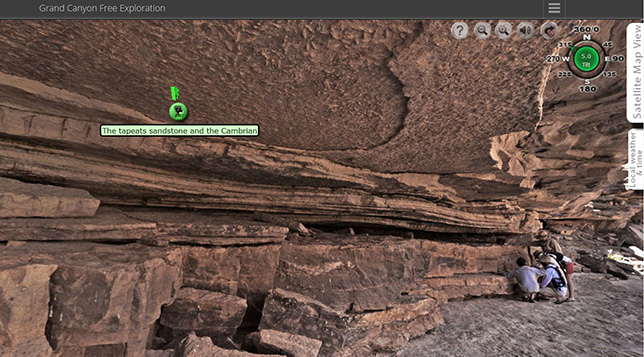
While birds chitter in the background, a group of students sit in their beach chairs at a beach camp set up near the Nankoweap Granaries, trying to pay attention as their professor gives them an introduction to the geology of that most remarkable of natural formations, the Grand Canyon. With a mouse click, you pick Mile 60, which transports you to another site right along the Colorado River, where students off to one side explore some part of an overhanging rock wall, while you choose to click a video icon that gives you access to quick lessons featuring Geologist Karl Karlstrom, speaking about tapeats sandstone and the "Cambrian explosion of life," which exposes traces from "some of the first animal life to be on earth." And that's just in the first five minutes of using one of the many virtual field trips Arizona State University has made freely available.
"Virtual Field Trips," offers interactive experiences captured during actual expeditions with scientists doing current research. Some of the trips include adaptive feedback and adaptive pathways. The resources are already being used in high school and college classrooms to supplement lessons in biology, earth sciences, geology, anthropology and other studies.
Students explore the chosen destination while answering questions that align with course materials. The adaptivity allows for "non-linear experiences," in which students may pursue different pathways and receive individual feedback tailored to their input and responses. For example, if a question is answered incorrectly, an instructor will pop up with a video to correct misstep and offer further instruction.
According to the university, the hands-on nature of the tool "connects with online students in a new way that encourages them to use all of their senses to complete the trip."
The field trips were created by the university's "Center for Education Through eXploration" (ETX), which espouses the practice of teaching based not on working through mastery of what is already known, but on "exploration of the unknown." The Center works with Smart Sparrow, a tech company that produces aero, an application for courseware development, and Studio, a consulting service that helps universities and companies create innovative courseware.
The virtual field trips work with multiple virtual reality headsets, including Google's low-cost Cardboard.
Among the field trips currently available are sessions on "dinosaur doom," "early civilizations," the rainforest and biological anthropology. New topics under development include "extreme environments, the earliest record of life," "driest deserts" and "beyond earth." The full roster is available on the ASU website.
About the Author
Dian Schaffhauser is a former senior contributing editor for 1105 Media's education publications THE Journal, Campus Technology and Spaces4Learning.