Grant to Fund More Research into Ed Tech Best Practices
The Jefferson Education Exchange (JEX) has received a $400,000 grant from the Carnegie Corporation of New York to extend the nonprofit’s efforts to find ways for schools to share information about their experiences with education technology. The grant will help to serve JEX's efforts to help educators across the country to identify and implement technologies that can help to serve their needs.
JEX provides stipends to teachers to document their experience with education technology. The organization also convenes researchers and association leaders across the U.S. to work together to find ways to define and measure new statistics and best practices.
"We are grateful to have the support of Carnegie Corporation of New York as we work to create a framework to help teachers, administrators, and district leaders not only choose technologies that are most likely to actually support their students — but also help those educators understand how to best implement and support those technologies, based on the experience of millions of their peers," said Bart Epstein, JEX's president and CEO.
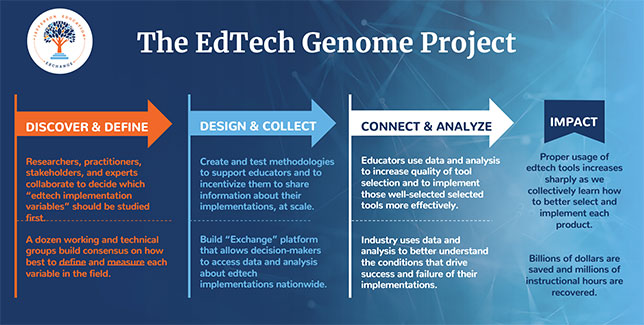
The grant will also help JEX to continue its work on the EdTech Genome Project. This new initiative will bring a group of educators together to conduct a study to determine the best ways to share the results of education technology implementations across the country. The goal is to help educators and industry determine which tools will suit their needs most effectively.
Participants selected for the EdTech Genome Project Steering Committee will shepherd the project to reach a consensus for the education sector in developing a common language and measures to quantify how sharing research findings can be most useful to educators and industry. More information will be shared about the project after the Steering Committee meets on Oct. 30.
JEX has received contributions from several organizations to fund its work. In April 2019, the Chan Zuckerberg Initiative announced $1.6 million in support of the nonprofit's efforts.
More information on JEX's work can be found here.
About the Author
 Sara Friedman is a reporter/producer for Campus Technology, THE Journal and STEAM Universe covering education policy and a wide range of other public-sector IT topics.
Friedman is a graduate of Ithaca College, where she studied journalism, politics and international communications.
Friedman can be contacted at [email protected] or follow her on Twitter @SaraEFriedman.
Click here for previous articles by Friedman.