Zenbo the Social Robot Teaches Kids Good Computing Safety Basics
- By Dian Schaffhauser
- 02/26/20
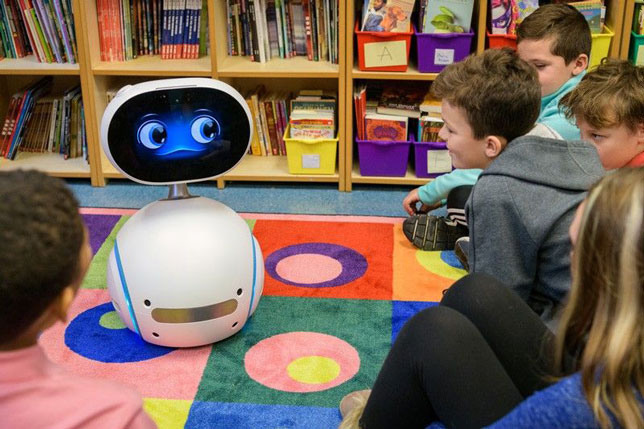
Fifth graders at the College School, located on the University of Delaware's Newark campus, watch Zenbo the social robot describe good habits for using safe computing. Photo: Evan Krape.
A cross-disciplinary project at the University of Delaware has resulted in the creation of a social robot that can deliver safe computing training to young students. Researchers from the university's College of Education & Human Development and the College of Engineering have worked together to produce and test the use of "Zenbo."
Zenbo, who stands two feet tall, is programmed to share familiar stories and solicit responses from kids 8 to 12 years old and then test their knowledge on topics like phishing and password safety.
The idea, according to campus reporting, is to help children learn the basics of cybersecurity and good digital citizenship habits, including the ethical and responsible use of the internet.
The researchers believe that the use of an interactive robot can boost student engagement over plain video watching and generate better outcomes in student knowledge about cybersecurity, especially for students with autism or emotional learning difficulties.
The robot has been tested with fifth graders from the College School, an on-campus school covering grades 1 through 8 and housed within the College of Education.
For example, the students recently listened as Zenbo delivered a rewrite of Little Red Riding Hood. The robot described how Red was leaving to visit her sick grandmother. But in this version, Red's mom has reminded her to safeguard the password needed to enter her grandmother's home. When she encounters the Big Bad Wolf in the woods, Red has to decide whether or not to share private information with a stranger.
When Zenbo asked the listeners what Red should do, their responses were split between sharing and not sharing.
"These checkpoints reinforce positive behaviors and create teachable moments for when children make mistakes," said Chrystalla Mouza, a professor in teacher education. "It's important that this training is provided in school because we cannot rely on it being provided elsewhere."
The research team plans to pilot Zenbo and a university-developed cyber safety curriculum in additional classrooms in spring 2020.
The project was funded by a $300,000 National Science Foundation grant.
About the Author
Dian Schaffhauser is a former senior contributing editor for 1105 Media's education publications THE Journal, Campus Technology and Spaces4Learning.