Study: AI Is Reshaping Work While Skills Erosion Remains Top Concern
AI is changing which human capabilities matter most at work, yet employees are reporting that some of those same capabilities are being eroded, according to a new study from IBM. Critical thinking, judgment and the ability to evaluate AI output sit at the center of that tension.
The IBM Institute for Business Value study, "Designing the Thinking Organization," is based on two surveys conducted with Oxford Economics from April through June 2026. IBM surveyed 1,500 CHROs and senior executives responsible for workforce strategy across 21 geographies and 23 industries, along with 8,800 full-time employees across 28 countries.
The chart below, created by ChatGPT from IBM's data, summarizes the executive-employee differences around critical thinking and AI oversight along with several of the report's other findings. The graphic also includes IBM's findings on skill erosion, CHRO participation in AI strategy, workflow definitions, AI adoption inside HR, and reinvestment of AI productivity gains.
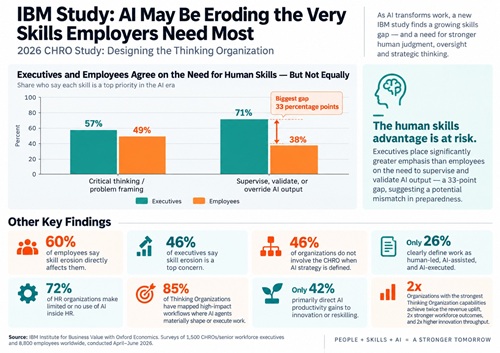 [Click on image for larger view.] Exec/Employee Disconnect (source: ChatGPT).
The findings extend beyond HR. More than half of employees surveyed — 52% — said their assigned tasks changed during the past year as AI reshaped day-to-day responsibilities. Yet only 26% of organizations clearly define work across human-led, AI-assisted, and AI-executed activities. IBM characterizes the situation as work changing faster than organizations are redesigning it, with day-to-day adaptation often taking the place of deliberate decisions about how people and AI should work together.
A Skills Gap Meets Skill Erosion
IBM found broad agreement between executives and employees on the importance of critical thinking and problem framing. Fifty-seven percent of executives and 49% of employees placed those capabilities near the top of the skills needed for AI-enabled work. A much larger divide emerged around evaluating AI itself: Seventy-one percent of executives prioritize the ability to supervise, validate, or override AI outputs, compared with 38% of employees — a 33-percentage-point gap.
An IBM announcement highlights another measure of that disconnect: Only 29% of employees rank judgment as important. The 29% figure measures employee prioritization of judgment and is distinct from the study page's 38% figure for supervising, validating, or overriding AI output.
The concern is not limited to skills workers still need to acquire. IBM said skill erosion is a top concern for 46% of executives, while 60% of employees say it directly affects them. The IBM Newsroom release says 60% of employees worry about skills erosion, with critical thinking cited most often as declining. Among employees who worry about erosion, IBM said three out of four report that AI has already begun to erode at least some of their skills.
IBM distinguishes that problem from a conventional skills gap. Eighty percent of enterprises have a reskilling roadmap for their workforce to collaborate with technology, according to the study. IBM argues that such programs address capabilities employees need to acquire but do not necessarily address existing skills that diminish as AI performs more of the underlying work.
That concern is also reflected in one of the executive perspectives included in the report. Dr. Amit Das, director and CHRO of Bennett Coleman & Co. Ltd., said, "The organizations obsessing over AI productivity gains are, in many cases, quietly hollowing out the developmental infrastructure that produced their own current leaders."
Workflow Design and Human Oversight
The study puts substantial emphasis on designing work around explicit divisions of responsibility between people and AI. IBM said organizations that clearly define workflows as human-led, AI-assisted, or AI-executed report 18% risk reduction and 20% quality improvement. At the same time, 46% of organizations do not involve the CHRO when AI strategy is being defined.
Accountability is another issue identified in the research. Thirty-six percent of executives said unclear accountability complicates AI deployment. IBM said work redesign should explicitly define ownership, validation, exception handling, escalation, and override within a workflow rather than leaving those responsibilities unspecified.
Employee experiences also differ depending on how judgment is incorporated into those workflows. Where judgment is built into the way work is done, 62% of CHROs report rising employee confidence in AI-enabled decisions. Where it is not, 57% report confidence declining. The Newsroom release separately says 43% of employees report that when something goes wrong with AI, the blame falls on them.
IBM also found that 85% of what it calls "Thinking Organizations" have mapped high-impact workflows where AI agents materially shape or execute work end to end. The company uses the term for organizations exhibiting 10 capabilities grouped across five focus areas: defining inherently human responsibilities, redesigning work and the workforce, advancing skills, shaping employee experience and culture, and building trusted AI inside HR.
Where AI Productivity Gains Go
The study also examines what happens to capacity created by AI. Only 42% of organizations primarily direct AI productivity gains toward innovation or reskilling, IBM said. The rest divide gains between savings and reinvestment, take them as cost reduction or profit, or lack a clear path from productivity improvements to new opportunities.
IBM's research links that question to employee development. The company says organizations can direct AI-created capacity toward coaching, development, internal mobility, stretch assignments, and innovation. Its report contrasts that approach with simply absorbing the capacity through additional work or capturing it as cost savings.
IBM reports substantially different outcomes among organizations with the strongest "Thinking Organization" capabilities. Those enterprises achieve twice the revenue uplift, twice the workforce outcomes, and twice the innovation throughput, according to IBM's analysis. The study also says 91% of Thinking Organizations report that employees have the skills needed to collaborate effectively with autonomous AI-powered technologies.
HR Is Still Early in Its Own AI Adoption
IBM's research assigns HR a major role in workforce transformation while also documenting limited AI adoption inside the function itself. Seventy-two percent of organizations make limited or no use of AI inside HR, according to the study. Meanwhile, digital and AI fluency is CHROs' top personal development priority, cited by 71% of respondents.
IBM says CHROs rate HR's capabilities particularly low in several areas: 13% for AI literacy across the team, 16% for AI performance measurement and 20% for change management related to AI adoption. IBM also reports that organizations with mature HR AI capabilities encompassing governance, architecture and measurement are nearly twice as likely to positively affect a higher number of business KPIs.
The report ultimately connects its skills findings with broader decisions about work design. IBM says organizations need to decide which activities remain human-led, which are assisted by AI, and which can be executed by AI; explicitly assign responsibility for validation and override; and address both new skills requirements and erosion of existing capabilities. Those recommendations accompany a workforce picture in which AI is already changing assigned tasks for more than half of surveyed employees while many organizations have yet to formally define the division of labor between people and AI.
For the full report, visit the IBM site.