WolfVision Rolls Out Low-Profile HD Visualizer
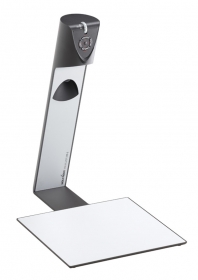
The VZ-3 visualizer offers native output of up to 1,280 x 960 and can stream images at up to 30 FPS. |
WolfVision has rolled out a new portable HD visualizer with camera, lighting system, and controls built directly into the unit's arm.
The visualizer, the VZ-3, uses an LED lighting system (with an estimated lamp life of up to 30,000 hours) and a single-CCD camera to stream images at the rate of 30 frames per second. The VZ-3 features native output resolutions of 1,280 x 960 (SXGA), 1,280 x 800 (WXGA), and 1,280 x 720 (720p), along with converted output resolutions of 1,024 x 768 (XGA) and 1,360 x 768 (WXGA).
For displaying visual aids that vary in size, the device is equipped with a 12x optical zoom and a 2x digital zoom, both controlled by a scroll wheel located at the top of the visualizer's arm. Additional visual adjustments include an auto iris that adjusts the brightness of an image incrementally, automatic white balance, automatic keystone correction, and an automatic focus that can be shut off if manual adjustments are needed.
The VZ-3 can be manipulated via computer, videoconferencing system, or room control system over USB or LAN connections. RS-232 links require a LAN or USB adapter.
The unit measures 19.2" (L) x 12" (W) x 19.9" (H) while standing. When folded, it measures 22" (L) x 12" (W) x 5.3" (H). To further reduce the profile of the VZ-3 and aid in its portability, the visualizer’s arm can fold over its working surface.
Additional feature include:
- A switch that activates or deactivates fade-over effects when toggling between images from the visualizer and images from external inputs;
- Auto power-off;
- Text mode;
- A removable working surface that can double as a dry-erase board;
- A button that switches between computer images and images streamed by the visualizer: and
- Power over Ethernet compatibility.
For security the VZ-3 offers threads for an included table lock bolt and a Kensington T-Lock port located on the bottom of the visualizer's arm.
AV, control, and peripheral ports include DVI-I, analog RGB/component (mini D-sub 15-pin), RJ-45, and USB.
The V-Z3 Visualizer is currently available.Further information can be found at wolfvision.com.
About the Author
Dan Thompson is a freelance writer based in Brea, CA. He can be reached here.