Christie Intros High-Light-Output DLP Projectors
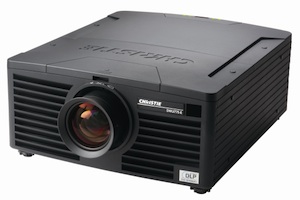
The Christie E Series offers light output of up to 7,000 lumens. |
Christie has debuted six new high-light-output education projectors built around single-chip (0.65- or 0.67-inch DMD) DLP technology. The projectors include four new models in Christie's E Series and two models in the new G Series, all offering light output greater than 5,000 lumens.
The two new G Series models include the Christie DHD550-G and DWU550-G. Both offer a dynamic contrast ratio of up to 5,000:1. The DHD550-G offers a resolution of 1,920 x 1,080 (1080p) and a brightness of 5,500 lumens; the DWU550-G offers a resolution of 1,920 x 1,200 (WUXGA) and has a brightness of 5,600 lumens.
Other features common to the G Series projectors include:
- Motorized zoom (zoom varies with the lens);
- Motorized focus;
- Motorized lens shift (offsets of ±120 percent vertical, ±20 percent horizontal);
- Built-in keypad;
- Ethernet LAN connectivity with ChristieNET (wireless dongle optional);
- Minimum 1,500-hour lamp life at full light output.
AV inputs include HDMI, DVI-D, DisplayPort, RGB (mini D-sub 15-pin),USB type B (display over USB), component video, S-video, and composite video. Networking and control ports include 10Base-T/100Base-TX Ethernet LAN (RJ-45), USB type A for viewing images or adding a wireless dongle, and RS-232.
The new E Series projectors include the Christie DHD675-E, DWU675-E, DHD775-E, and DWU775-E. The DHD675-E and DHD775-E offer a resolution of 1,920 x 1,080 and light output of 6,450 lumens. The DWU675-E and DWU775-E are WUXGA projectors (resolution of 1,920 x 1,200) and offer a brightness of 7,000 lumens. All four models have a 5,000:1 dynamic contrast ratio.
All four of the new models also sport:
- Dual lamp;
- Motorized zoom (zoom varies with the lens) or fixed lens;
- Motorized focus;
- Motorized lens shift (offsets of ±138 percent vertical, ±20 percent horizontal);
- Built-in keypad;
- Ethernet LAN connectivity with ChristieNET (wireless dongle optional);
- Minimum 1,500- or 1,800-hour lamp life at full light output.
AV inputs include dual HDMI, DVI-D, 5BNC, DisplayPort, RGB (mini D-sub 15-pin),USB type B (display over USB), component video, S-video, and composite video. Networking and control ports include 10Base-T/100Base-TX Ethernet LAN (RJ-45), USB type A for viewing images or adding a wireless dongle, and RS-232.
Christie has not yet revealed pricing on the new units. The company reported it will display the four new E-series models at the LDI conference beginning Oct. 19. The G-series models will be displayed at the Educause 2012 conference in Denver beginning Nov. 7. Additional details can be found on Christie's site.