Entry-Level BenQ Projectors Blast 3,500 Lumens
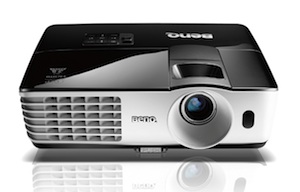
The DLP-based BenQ MW663 offers a WXGA resolution of 3,000-lumen brightness and sells for $799. |
BenQ is rolling out a new line of entry-level DLP projectors, its M6 series. The lineup includes four models, all of them capable out outputting at least 2,800 lumens.
The M6 series includes two short-throw projectors: the MS616ST and the MX618ST. The MS616ST is n SVGA projector (800 x 600 resolution), offering a 13,000:1 contrast ratio and a brightness of 3,000 lumens. With a throw ratio of 0.9 to 1.08, it can produce an image 32" to 300".
The MX618ST offers a higher XGA resolution (1,024 x 768) with a slightly lower brightness rating of 2,800 ANSI lumens. Its features are otherwise identical to the MS616ST.
Other features common to both of the short-throw projectors include:
- Vertical keystone correction (±40 degrees);
- Projection offset 110 percent (±5 percent);
- Integrated mono 10 watt speaker; and
- 1.2x zoom.
The two new standard-throw projectors include the MX662 and the MW663. The MX662 is an XGA projector with a 3,500-lumen brightness and a 13,000:1 contrast ratio. It has a 1.1x zoom.
The high-end model of the bunch, the MW663, offers a WXGA resolution (1,280 x 800) and a brightness of 3,000 lumens. It offers a 1.3x zoom. It's otherwise feature-identical to the MX662.
Other features common to both standard throw projectors include:
- ±40 degree vertical keystone correction;
- 120 percent projection offset (±5 percent); and
- Integrated mono 2 watt speaker.
AV inputs on all four of the new models include HDMI, RGB (mini D-sub 15-pin), S-video, composite video, stereo RCA jacks, and stereo minijack. AV outputs include RGB and stereo minijack. Networking and control ports include USB type A, mini-USB type B, RS-232, and dual IR receivers.
All of the projectors also offer options for wireless connectivity and can be integrated with BenQ's Qpresenter app for the iPhone and iPad.
All of the models are available now. The BenQ MS616ST lists for $699; the MX618ST sells for $899; and the MX662 and MW663 are both priced at $799. Additional details can be found on BenQ's education projector portal.