Colfax High Students Learn Product Development with 3D Prototyping
- By Dian Schaffhauser
- 03/21/14
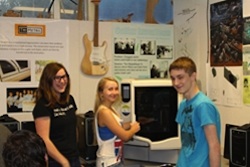
From left, Colfax High School students Autumn Turner, Hailey Elias and Alec Cobabe have invented a ski sensor and are learning product design as part of a community college STEM initiative. |
Hailey Elias had joined her high school alpine ski team, and her coaches were "consistently" telling her to lean forward. Like most beginning skiers, the 15-year-old was in the habit of putting "too much weight" in the back of her heels, which caused her to be off balance. She came up with the idea of developing something that could be put in the boot to remind her when she was leaning back instead of forward. That idea turned into an invention appealing enough for consideration by Quirky, a company that takes people's ideas and does the work of turning them into products that are sold.
In this case, Elias and two classmates at Colfax High School in California developed a prototype of a device that signals to skiers when they're doing what they shouldn't do — lean back. The prototype of the "Fast Forward" ski sensor was chosen by the audience as worthy of further exploration by Quirky during the March South by Southwest Conference in Austin, TX. That event included panel member Bill Nye the Science Guy.
"When Bill Nye clapped for it, I screamed out loud because I was so excited he approved of it," said Elias, who viewed the panel presentation online. "I remember watching him when I was little and I'm still a fan-girl."
The battery-powered Fast Forward clips onto the back of the heel of a ski boot. The device includes an agitator motor that vibrates when the skier's leg presses against a trigger to remind him or her not to lean back. This replaced an earlier idea of creating a boot insert, which turned out to be intrusive.
| |
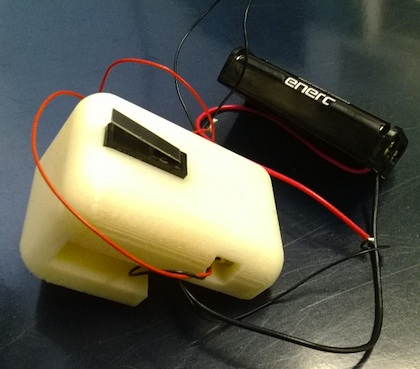
The Fast Forward helps begining skiers remember to lean forward by vibrating if they lean back far enough to depress a trigger. |
|
The next gauntlet for the device is to be picked for development by Quirky, which means rising to the top of the stack through a combination of public crowdsourcing and private beer-fueled debate.
The students had been learning about product development in an engineering class taught by Jonathan Schwartz. To create components of their prototype, Elias and fellow students Autumn Turner and Alec Cobabe used a 3D printer supplied by the local Sierra College Science, Technology, Engineering & Math (STEM) Collaborative. Then they wired up the final gadget, tested it on ski boots, made refinements and produced a video about it for submission to Quirky.
The collaborative is funded by the California Community College Chancellor's Office with the goal of creating a pipeline of students interested in technical careers.
Now Schwartz is developing a "Design Challenge" curriculum using the Quirky model. "The students couldn't have designed and tested the ski sensor prototype without the 3D Printer supplied by Sierra College STEM," he said. "Seeing the Quirky evaluation process gave the students a new perspective. They applied their math, reasoning, writing and critical thinking skills to define a problem and work toward a solution. They went through multiple iterations of designing and testing the prototype until it was perfected."
The course and the prototyping process have had an impact on Elias. "Hailey views the world differently now," said her father, Don Elias. "She sees problems from a solution-oriented point-of-view and thinks, 'How can an invention help alleviate the situation?'"
About the Author
Dian Schaffhauser is a former senior contributing editor for 1105 Media's education publications THE Journal, Campus Technology and Spaces4Learning.