American Students Ahead of the Curve on PISA Problem Solving Scores
|
Take the PISA Problem-Solving Test
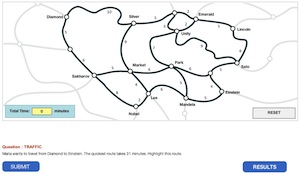 OECD has made a handful of sample questions from the problem-solving test available to the public. The questions are computer-based and require interaction with objects on the screen. Visit OECD.org. OECD has made a handful of sample questions from the problem-solving test available to the public. The questions are computer-based and require interaction with objects on the screen. Visit OECD.org.
|
No, this isn't an April Fool's joke. There's actually good news about American education coming out of the Program for International Student Assessment (PISA), the triennial international assessment that ranks countries based on their students' proficiency in math, science and language arts (as measured by standardized tests).
In data released today from the 2012 international assessment, on average 15-year-old students from the United States showed a greater degree of proficiency in problem solving, in particular on tasks for which they are required to uncover information in order to solve the problem, than their peers from other countries.
U.S. students, with an average score of 508, didn't rank highest in problem-solving — that distinction went to Singapore — but they did beat the average proficiency score (500) of the 85,000 students who participated in this particular assessment. (Those students represented 44 nations that participated in the 2012 assessment, most of whom are members of the Organization for Economic Cooperation and Development, also known as OECD.)
The actual numbers, which can be found on nces.ed.gov, show that about four-fifths of American 15-year-olds are at or above minimal proficiency (proficiency level 2) in problem solving, with the remaining 18.2 percent below that level.
The numbers break down as follows:
- 5.7 percent of American students were below proficiency level 1 versus the international average of 8.2 percent;
- 12.5 percent were at level 1, slightly below the international average of 13.2 percent;
- 22.8 percent were at level 2, the minimum level considered "proficient," compared with 22 percent internationally;
- 27 percent were at level 3 compared with 25.6 percent internationally;
- 20.4 percent were at level 4 compared with 19.6 percent internationally;
- 8.9 percent were at level 5 (tied with the international average); and
- 2.7 percent were at the highest level of proficiency, level 6, just beating the international average of 2.5 percent.
According to a report released by OECD, "Fifteen-year-olds in the United States perform strongest on interactive tasks, compared to students of similar overall performance in other countries. Interactive tasks require students to uncover some of the information needed to solve the problem themselves. This suggests that students in the United States are open to novelty, tolerate doubt and uncertainty, and dare to use intuition to initiate a solution."
On the down side, compared with the highest-performing nations (Singapore, Korea and Japan), the largest gaps were seen in "tasks where students must select, organi[z]e and integrate the information and feedback received in order to represent and formulate their understanding of the problem."
Performance of American boys and girls was roughly equal (a three-point difference in the average versus a seven-point difference among all participating countries). But there was a significant disparity between immigrant and non-immigrant scores, with non-immigrants scoring on average 14 points higher than immigrants (512 versus 498).
Additional details can be found on the PISA site. Sample problem-solving questions are also available to the public.