Tech Purchases Dominate Back-to-School Shopping
Parents plan to spend the bulk of their increased back-to-school budgets on tech-related items, according to a recent survey.
Back-to-school shopping is already underway, and parents this year plan to spend the bulk of their increased back-to-school budgets on tech-related items, according to a recent survey by Rubicon Project, a Los Angeles-based online advertising technology company.
Though school supplies and apparel remain the top priorities in this year’s survey, the biggest budget item for both K-12 ($343) and college freshmen parents ($470) was technology.
Also, for the first time ever, most parents plan to skip brick-and-mortar outlets for their tech purchases, picking Amazon as their go-to retailer for technology. This year, adoption of online and mobile shopping has reached a high water mark, with 60 percent of all parents surveyed planning to use mobile devices for some back-to-school shopping. Thirty percent plan to do at least a quarter of their total shopping on mobile devices.
“Parents’ busy schedules have them increasingly turning online and to their mobile devices to make purchases, transforming the way they shop for their child’s back-to-school apparel, supplies and technology,” said Harry Patz, chief revenue officer for the Rubicon Project, in a prepared statement.
Interviews for the survey were conducted from June 3 to June 8. Rubicon Project hired global polling firm Penn Schoen Berland to conduct 1,506 interviews among parents, including 1,000 interviews among parents of children entering grades K-12 and 506 interviews among parents of students entering their first year of college.
Overall, the firms have estimated that millions of parents — more than a third of all parents surveyed (34 percent) and nearly half of college freshman parents (49 percent) — have already started back-to-school shopping. Sixty-one percent of all parents plan to spend more than they did last year, budgeting approximately $917 per child on average, the survey said. Freshmen parents plan to spend more than $1,300 per child, twice what the average K-12 parent plans to spend.
“Back-to-school is one of the biggest shopping events of the year, and parents aren’t afraid to open up their pocketbooks to ensure their children are best prepared for the next grade,” Patz said.
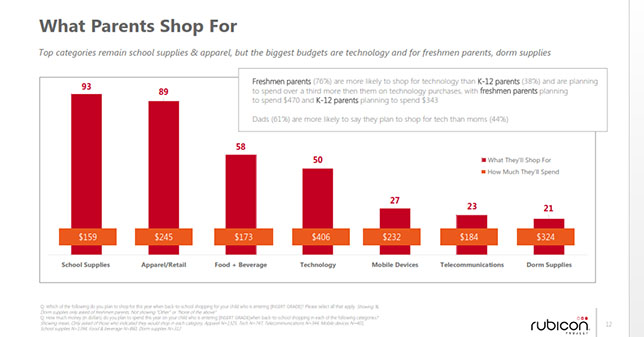
Here are some other findings from the survey:
- More than half of parents interviewed plan to shop for technology and telecommunications online, while apparel, school supplies and food and beverage remain primarily brick-and-mortar shopping purchases.
- Amazon has claimed the top spot as parents’ No. 1 retailer for technology, as parents increasingly turn to the online retailer for major purchases such as laptops, tablets and other devices.
- For K-12 parents, Amazon has moved ahead of Staples as the third most popular destination for school supplies compared with last year. (In 2015, Staples accounted for 39 percent, Amazon for 38 percent.)
- Dads are getting more involved in K-12 back-to-school shopping, especially when it comes to technology. Dads outpace moms in mobile purchasing, as 41 percent of fathers said they would do at least a quarter of their online shopping on a mobile device, compared to just 24 percent of mothers.
- Tablets continue their popularity, with tablet purchase intent up overall from 2015 and about half (51 percent) of K-8 parents who said they’re shopping for tech are also shopping for tablets.
- In the battle of PC vs. Mac, PCs rule: PCs (72 percent) continue to dominate planned computer purchases for parents of both K-12 and college freshmen. For mobile devices, Android (52 percent) outpaced iPhone (42 percent) in purchasing preference.
- K-12 parents are 9 percent more likely to watch video through a streaming service or other channels/websites daily than they were in 2015 (30 percent in 2015 vs. 39 percent in 2016).
- Retailer mobile applications are becoming increasingly popular, as almost half of parents surveyed (47 percent) have the Amazon mobile application and 40 percent of college-bound freshmen parents utilize at least three shopping apps. Seventy-one percent of parents plan to use retailer apps before they make a purchase, while 66 percent use mobile apps to compare prices and 64 percent use them to find out about sales.
More information about this survey can be found on the Rubicon Project’s website.
About the Author
Richard Chang is associate editor of THE Journal. He can be reached at [email protected].