Is Effective Ed Tech Implementation Extremely Important? Depends Who's Being Asked
A new report out from Project Tomorrow revealed a substantial disconnect between teachers and administrators on technology implementations in schools. The report also highlighted a dearth of systemic change resulting from ed tech adoptions.
The report, Teachers' Readiness and Willingness to Adopt Digital Tools for Learning," was released at the ASU+GSV Summit taking place this week in Salt Lake City, UT, with results from the latest national Speak Up Survey, which collected data from more than 500,000 students, administrators and classroom teachers.
Among the findings:
- District administrators to a much greater degree than classroom teachers say that effective implementation of education technology is "extremely important" to student success (71 percent administrators versus 43 percent teachers). School principals were in the middle at 60 percent.
- That's not to say teachers were completely dismissive of ed tech. Fifty-four percent said effective implementation is "important" to student success.
- Only 35 percent of educators see the use of mobile devices as having a positive impact on students' work, though 75 percent of them indicated the devices improve student engagement.
- Teachers are not using technology in ways that bring about "systemic change" in their practices, such as designing personalized learning "paths" for students, identifying "promising instructional strategies for replication" or working "with individual students on learning goals." Rather, they're using tech for things like parent communications and collaborating with other teachers, which, as the report noted, "are activities teachers have always done and they are very important, but they would do these regardless of technology."
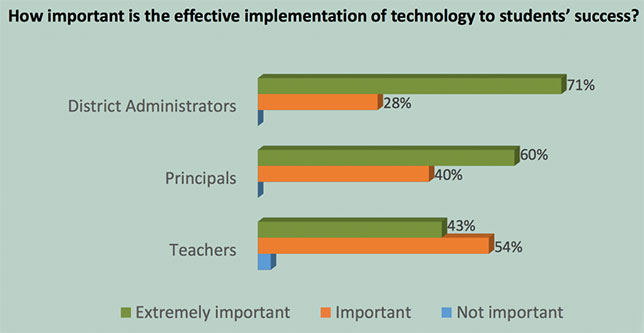
Chart courtesy of Project Tomorrow.
According to the report: "Yes, the chalkboard is a white board and paper and pencils have been replaced with laptops, but other than that? Beyond the physical differences we see in classrooms, the other changes we have seen are minimal — despite the opportunities technology presents to transform learning."
Complete findings can be found on Project Tomorrow's site.