Teachers and Historians to Develop Free, Open Online Curriculum
- By Dian Schaffhauser
- 08/25/17
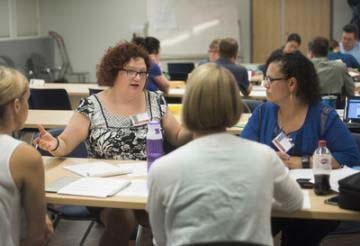
Teacher Laura Rangel, left, works with a group of other educators to plan a world history lesson using primary sources during a summer teaching event at the University of California, Davis. Source: UC Davis/Karin Higgins
Historians and teachers in California are working together to develop free, open, online instructional materials for teaching history and social sciences in K-12. Scheduled to be available by July 1, 2019, the new content will adhere to a history-social science framework adopted by the state's Department of Education in 2016. The curriculum will include digital versions of primary and secondary sources, lesson plans and related instructional materials.
State lawmakers have committed $5 million to the work. The San Francisco Unified School District is acting as the administrator for the initiative, work that primarily involves managing a contract with the San Francisco-based California Historical Society. In turn, the society is partnering with the California History-Social Science Project. The CHSSP is housed in the University of California, Davis, which will receive more than $1 million for its participation in the project.
"Teaching California," as the new curriculum is called, integrates history and social science content while also supporting student literacy, English language proficiency, civic engagement, all bundled into an inquiry-based model of instruction.
The framework upon which the curriculum will be based was created under the guidance of CHSSP, which is holding a series of "framework launch conferences" around the state. Upcoming workshops will take place through May 2018 in Santa Clara, Pomona, East Bay, Fresno, Riverside, and Sonoma.
With the new instructional materials first graders will gain an understanding of their place "in time and space." Fifth graders will learn about the expansion of the country. Students in 10th grade will examine the impact of "revolutions" such as the Enlightenment and the Age of Reason on society and why the modern period was defined by global conflict and cooperation, economic growth and collapse, and global independence and connection.
"At the heart of Teaching California is a one-of-a-kind partnership between a state historical society and a statewide network of history educators, working together to help California students understand and appreciate the contributions of Californians to our national history and our global past," said Nancy McTygue, CHSSP's executive director, in a prepared statement. "Teaching California will offer schools, teachers, and students a free and classroom-ready collection of resources designed to engage children in exciting and inspiring investigations of the past. At the same time, the collection will offer teachers a research-based approach to improve student reading, writing and critical thinking."
About the Author
Dian Schaffhauser is a former senior contributing editor for 1105 Media's education publications THE Journal, Campus Technology and Spaces4Learning.