Report: Rural Districts Deserve More Policy and Research Focus
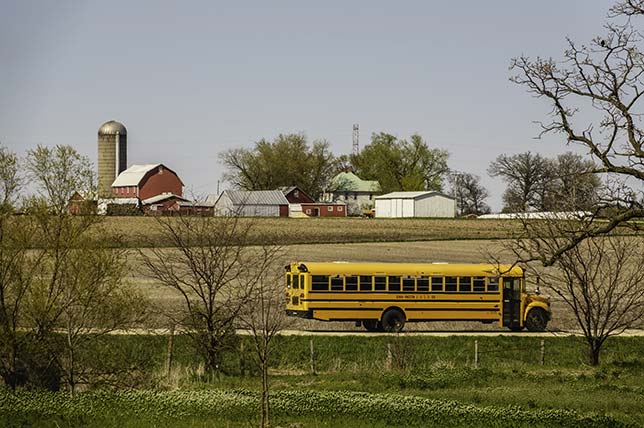
Nearly 20 percent of the nation's students attend rural schools, but those students are largely ignored by policy makers and researchers, according to a new report from the National School Boards Association's (NSBA) Center for Public Education (CPE), leaving unaddressed issues stemming from poverty, isolation and other inequities.
"No one seeks to minimize the problems of rural schools," according to the report. "But, at least from a national perspective, the unique needs of rural education are often obscured by their urban and suburban counterparts. One possible reason is that the majority of American students are educated in urban and suburban schools, which may lead policymakers to focus their attention and efforts on improving education where it will have the largest impact. However, such a metropolitan-centric attitude neglects a significant portion of the student population. Approximately one-half of school districts, one-third of schools, and one-fifth of students in the United States are located in rural areas."
Key findings of the report, dubbed "Out of the Loop," include:
- Nearly two-thirds, 64 percent, of rural counties have high child poverty rates and rural children are more likely to live in households with less than half the income of the poverty line, also known as deep poverty. Only 47 percent of urban districts have high child poverty rates;
- The average rural school only offers half the number of advanced math courses that the average urban school does;
- Nearly half of rural students attend schools that only offer three advanced math courses;
- Only 73 percent of rural schools offer at least one advanced placement course in any subject, compared to 95 percent of suburban schools and 92 percent of urban schools;
- Only 62 percent of rural schools offer at least one advanced placement course in a STEM subject, compared to 93 percent of suburban schools and 88 percent of urban schools;
- Rural students are more likely to graduate high school than their urban peers and even low-income rural students exceed the national graduation average, but rural students are also less likely to hold a college degree, at a rate of 5 percent versus 62 percent for urban students;
- There is a 10-percentage-point gap between the share of rural teachers who hold a master's degree and the share of urban teachers who do;
- The more isolated a school's community is, the less likely its teachers are to hold postgraduate degrees;
- Rural schools report difficulty filling positions more frequently, especially for STEM subjects;
- Rural districts receive, on average, 17 percent of state school funding;
- Rural schools with consolidated districts tend to have high transportation costs, as students must be bussed in over great distances;
- School choice is not an option for many rural districts, as the population is too sparse to support multiple options. Only 11 percent of charter schools are in rural districts, while 565 percent are located in urban districts; and
- Virtual schools are similarly off the table, as two-thirds of Americans lacking a home internet connection live in rural districts and slow internet connections plague many rural schools.
"Rural schools face many of the same challenges as their urban counterparts — high poverty and inadequate resources among them," said Patte Barth, director of the Center for Public Education, in a prepared statement. "Yet as our report shows, the proposed solutions for metropolitan settings, such as school choice and extended time in school, don't necessarily serve the unique circumstances of less-populated communities. Clearly, the nation needs a specific focus on policies and practices that will improve outcomes for the one-fifth of its children who attend rural schools."
To read the full report, visit centerforpubliceducation.org.
About the Author
Joshua Bolkan is contributing editor for Campus Technology, THE Journal and STEAM Universe. He can be reached at [email protected].