Organizations Hard Put to Keep Pace with SDN, Networking Trends
Organizations are struggling to keep pace with new developments in the networking industry, according to a new report.
"Between multiprotocol label switching (MPLS) and software-defined networking (SDN), there were about 15 years where the networking world was pretty static," said Avi Freedman, co-founder and CEO of network analytics firm Kentik, which conducted the survey. "Right now we're in a world moving as fast as the ISP world did back in the 90s. Every few weeks there's something new."
The firm polled 531 networking pros during the recent Cisco Live 2018 conference to determine current networking trends and how organizations are addressing industry challenges.
One key finding from the resultant report is that the top trend in networking is automation, named by about 36 percent of respondents. It beat out other trends such as advanced analytics for network or security, hybrid/multi-cloud migration and Internet of Things (IoT).
"Automation has always been a goal for network operations teams," Freedman commented. "However, with the complexity of infrastructure growing so quickly, it is increasingly being prioritized. Organizations lack the resources to scale linearly, so they are looking to automation, not as a way to replace jobs, but as a solution to help reduce errors and manage it all."
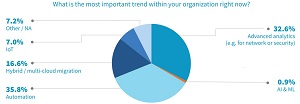 [Click on image for larger view.] Top Networking Trends (source: Kentik).
Perhaps surprisingly, artificial intelligence (AI) and machine learning (ML) ranked far down the list, despite their accompanying industry buzz. Fewer than 1 percent of respondents believed it to be a most important trend, though a much higher percentage (45.2 percent) found it to be helpful for network management.
Another key finding from the "The 2018 State of Network Management" report found that a data breach was "the biggest network worry" (listed by 33.1 percent of responses). Trailing right behind that security concern was user experience (28.8 percent of responses). The report said that as more organizations conduct their business online, network outages are more directly related to customer success for many companies across different industries.
"While the industry's pace of innovation offers guaranteed excitement, our survey findings also reveal that organizations ultimately need a better understanding of their infrastructure in order for their businesses to benefit from all of the new developments," Freedman concluded.
Kentik said survey respondents came from a wide range of industries, such as education, finance, insurance, government, healthcare, manufacturing, technology, telecommunications, transportation and utilities organizations. Respondents' titles ranged from C-level, to SVP/VPs, directors, and managers, to network and security engineers, architects and associates, with most coming from organizations with 1,000 or more employees.
About the Author
David Ramel is an editor and writer at Converge 360.