Report: Emotional Well-Being investment Improves Student Outcomes
A new survey finds schools that place an emphasis on student emotional well-being have better cognition outcomes.
More educators across the world are investing in the emotional well-being of their students as a harbinger of success, according to a new survey commissioned by Microsoft and produced by The Economist's Intelligence Unit. The report surveyed 762 educators across 15 countries at the elementary and secondary school levels.
"We are seeing emotional well-being become a very intentional input that needs to be embedded and addressed a whole school level," said Mark Sparvell, an education thought leader at Microsoft. "We are getting this message that the kids are not alright. There is positive pressure coming from education, research and policymakers to address emotional well-being."
The survey found 79 percent of educators see positive emotions as very or extremely important for academic success and half of all educators are working in schools with explicit emotional-being policies. Educators in Brazil, Chile and Mexico are the most enthusiastic and proactive adopters of well-being policies and ideas, and nearly two-thirds agree that prioritizing student well-being and emotional health is important to develop them into healthy adults and responsible citizens.
"The indication is that social, emotional and academic learning in Latin America is tied together," said Sparvell. "The well-being at a school level requires a particular vision for the kinds of learners that a school is seeking and that well-being needs to be embedded in the curriculum."
When it comes to engaged educators, the survey found 37 percent of educators believe that students' emotional well-being is "inextricably linked" to their academic success. Seventy percent of these engaged educators think that the topic of emotional well-being has become much more important over the recent years, and 53 percent of these educators work in schools that have formal well-being policies.
To help students and teachers improve their emotional well-being capabilities, technology plays a part in enabling emotional health. Data gathering and analytics tools play the strongest role in helping teachers encourage student well-being at 49 percent and 46 percent, respectively. While online games and virtual assistants are widely discussed as potentially valuable additions to the personalized learning agenda, approximately 15 percent of educators find these solutions useful.
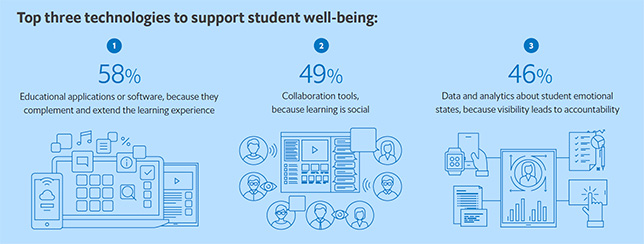
"When students are able to receive feedback on their emotional state and leaders are able to get information on how their students are functioning, then it can lead to reactions from educators," said Sparvell.
When it comes improving the emotional health of students, the report provides a list of best practices.
- Gather data to identify students' mental and emotional health and track whether supportive measures are working.
- Involve teachers in the development of well-being plans.
- Make investments in expertise to design and deliver empirically-sound instruction and content and educate teachers on how to delivery this content.
The full findings of Microsoft's survey report can be found here.
About the Author
 Sara Friedman is a reporter/producer for Campus Technology, THE Journal and STEAM Universe covering education policy and a wide range of other public-sector IT topics.
Friedman is a graduate of Ithaca College, where she studied journalism, politics and international communications.
Friedman can be contacted at [email protected] or follow her on Twitter @SaraEFriedman.
Click here for previous articles by Friedman.