NAEP Data Reveals Uneven Music Access
- By Dian Schaffhauser
- 06/03/19
A new analysis by the Education Commission of the States has identified those states where students do and don't play musical instruments outside of school. This activity has been shown to boost children's skills in numerous ways: motor, auditory, verbal and cognitive. It has also helped strengthen their vocabulary and improved their executive functioning. The commission is a national compact of states that work together to improve education by sharing data and best practices.
The music analysis used data from the 2017 Nation's Report Card in mathematics, which is given to students in grades 4, 8 and 12. The 2017 version of the survey asked respondents how often they played an instrument and read music outside of school.
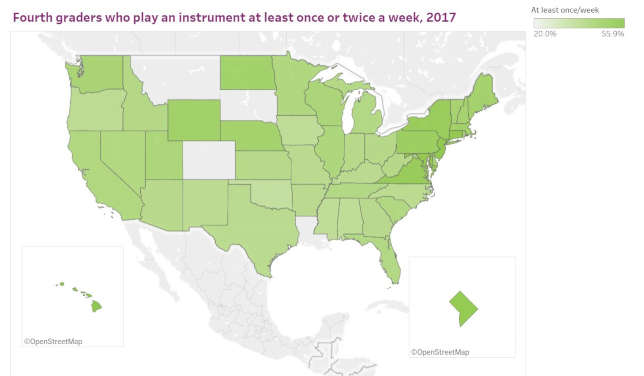
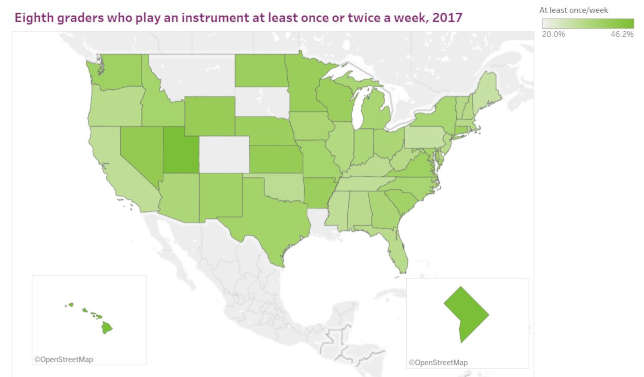
The study of the responses by the Commission focused on students in grades 4 and 8, specifically, who reported that they played an instrument and read music at least once or twice a week.
As a report on the findings explained, fourth graders were more likely than eighth graders to play outside of school, 41 percent compared to 34 percent. Fourth-grade girls were more likely than boys to be involved in music outside of school (49 percent versus 38 percent). And students in grade 4 who qualified for free or subsidized lunch were "significantly less likely than their wealthier peers" to play an instrument outside of school (40 percent compared to 48 percent). Across the country, students reporting their race or ethnicity as Asian/Pacific Islander were far more likely to play an instrument compared to their peers (53.5 percent versus 44 percent for those reporting as White or Black, 40 percent for students reporting as Hispanic and 36 percent for those who said they were American Indian or Alaska Native).
As Claus von Zastrow, author of the analysis, suggested, in light of the multiple benefits of playing an instrument, "Policymakers, funders and community leaders can address such gaps by supporting instrumental music in low-income schools and promoting after-school music programs in communities that lack them."
The full analysis is openly available on the Commission's blog, EdNote. Data is provided on a national basis and state-by-state.
About the Author
Dian Schaffhauser is a former senior contributing editor for 1105 Media's education publications THE Journal, Campus Technology and Spaces4Learning.