NSF Grant to Cover Master Degrees in STEM Teaching and Bonuses
- By Dian Schaffhauser
- 03/21/18
A six-year project at the University of Houston will develop, mentor and retain 30 STEM teacher-leaders in high-need school districts. The $2.8 million from the National Science Foundation will cover tuition and fees for teachers working in middle and high schools to earn their master of education degrees with an emphasis on science, technology, engineering and math; they'll also receive a $10,000 annual stipend for four years afterwards to train other teachers in schools serving populations of students who are under-represented in the STEM fields.
The program, "Enhancing STEM Teacher Leadership Through Equity and Advocacy Development (LEAD) in Houston," is expected to reach 150,000 students in the greater Houston area. According to the program investigators, the project may also serve as a model for other teacher-leader development efforts across the United States.
LEAD Houston is a joint effort of the university's College of Natural Sciences and Mathematics and the College of Education. The grant was awarded to the teachHOUSTON program, also a collaboration between the two colleges, this one focused on preparing secondary math and science teachers.
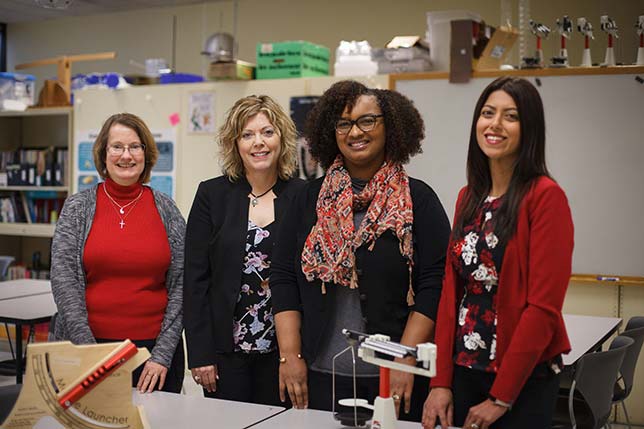
From left to right, Jennifer Chauvot, chair, Department of Curriculum and Instruction; Paige Evans, clinical professor, teachHOUSTON; Leah McAlister-Shields, teachHOUSTON academic program manager; and Mariam Manuel, instructional assistant professor, teachHOUSTON. Source: University of Houston
Teachers selected as candidates will have their tuition and fees covered over the 14-month master's program; they'll receive the supplements to their salaries to lead STEM professional development in their own schools after they've finished the program; and they'll also receive their own PD experiences, including instructional coaching, policy advocacy and culturally-responsive teaching.
The latter, explained Leah McAlister-Shields, teachHOUSTON academic program manager, recognizes that culture affects how students learn. Culturally-responsive teaching influences the "types of images you use in your classroom, the types of books that you reference -- all of these are important for normalizing a student's experience through use of their own cultural references."
The colleges will work with high-need school districts in the Houston region and the National Math and Science Initiative, a Texas-based nonprofit, to recruit and prepare two cohorts of 15 secondary STEM teachers to take part in LEAD Houston.
"Ideal candidates," according to co-principal investigator Mariam Manuel, an instructional assistant professor in teachHOUSTON, "are passionate about their craft, embody a growth mindset and have the desire to impact change in their own classrooms and the classrooms of other in-service and preservice teachers."
"The opportunities for growth provided through this grant are numerous and transformational," said Paige Evans, a clinical professor in teachHOUSTON in the Department of Mathematics and principal investigator for the grant. "Our goal is to develop teachers to serve as leaders within their own schools, communities and even on a national platform."
Teachers interested in applying to the LEAD Houston program can learn more on the LEAD Houston website.
About the Author
Dian Schaffhauser is a former senior contributing editor for 1105 Media's education publications THE Journal, Campus Technology and Spaces4Learning.