LED-Lit Robotic Garden Encourages Kids To Code
- By Dian Schaffhauser
- 02/23/15
The developers of a robotic garden from MIT are hoping it becomes a tool to encourage students — especially girls — to understand more about algorithms and programming. A team from both the institute's Computer Science and Artificial Intelligence Lab (CSAIL) and the Department of Mechanical Engineering has developed a tile system that can be used to manage the garden via a tablet or a device with Bluetooth. Users can make a given flower or bunches of flowers bloom or change their colors by communicating with LED lights and dozens of tiny robots. More advanced users can also add their own commands and execute sequences in real time.
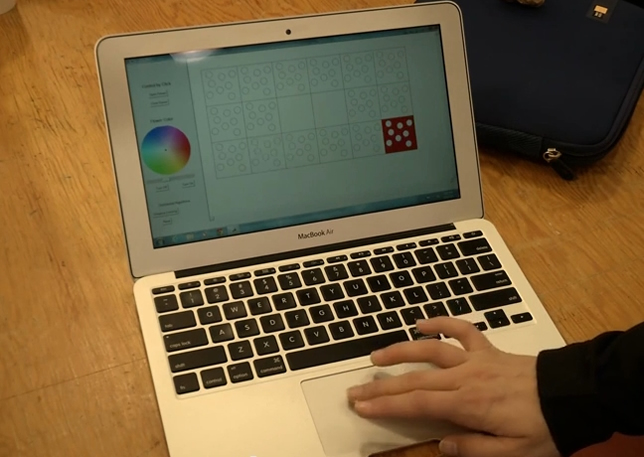
Each of 16 tiles are tied together with Arduino microcontrollers and programmed to respond in different ways. A "graph-coloring" algorithm defines color distribution such that no two adjacent tiles share the same color — if the user so chooses.
"Students can see their commands running in a physical environment, which tangibly links their coding efforts to the real world," said Lindsay Sanneman, a software engineer at CSAIL and lead author on a paper that describes the work. "It's meant to be a launchpad for schools to demonstrate basic concepts about algorithms and programming."
Sanneman and her colleagues have had their paper on the project accepted for presentation at the 2015 International Conference on Robotics and Automation. According to a statement from the research team, the report describes the system's dual functions "as a visual embodiment of their latest work in distributed computing," as well as a way to draw more young students into programming.
According to PhD candidate and contributor Joseph DelPreto, many of the elements in the garden could be made "very quickly." That includes the LED flowers as well as "pouch motors," pneumatic actuators for origami structural robots, such as the flowers. "We're hoping that rapid fabrication techniques will continue to improve to the point that something like this could be easily built in a standard classroom," he said.
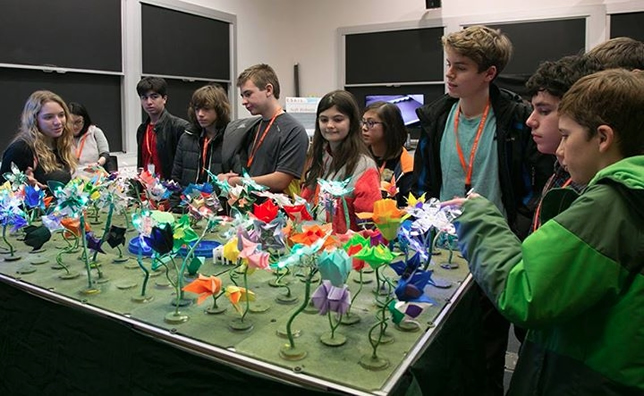
Sanneman and DelPreto demonstrated the garden during an "hour of code" event last December. They intend to integrate it into curriculum they're developing for middle and high schools that involves the use of printable robots that the students can program.
They also hope to make the garden operable from multiple devices at the same time and to add microphones and music that would enable sound to be synchronized with the motion of the objects in the garden.
"Computer science has so many real-world applications that a lot of kids don't see because they aren't exposed to them from an earlier age," Sanneman says. "That's why we think there's a lot of potential for tools like this."
About the Author
Dian Schaffhauser is a former senior contributing editor for 1105 Media's education publications THE Journal, Campus Technology and Spaces4Learning.