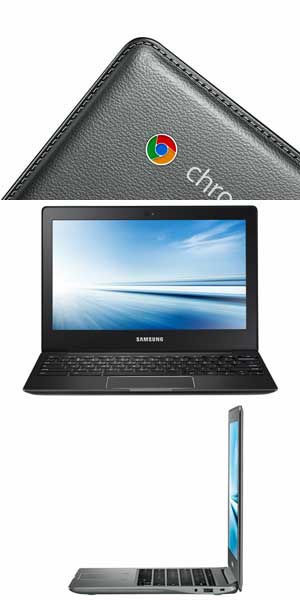
Samsung Reveals 8-Core Chromebook 2

The Samsung Chromebook 2

Samsung has unveiled its next-generation Chromebook 2 line, which will sport Exynos 5 Octa processors with eight processing cores (four ARM Cortex-A15s and four ARM Cortex-A7s). The Chromebook 2, designed for schools, will be available in two configurations, offering different screen sizes and processor speeds.

The 13.3-inch Samsung Chromebook 2, set to ship in April, will use the new 64-bit, 2.1 GHz Exynos 5 Octa with 2 MB level-2 cache. That model also offers a 1080p HD display (1,920 x 1,080 pixels). It will offer 8.5 hours of battery life and will weigh in at about 3 pounds.

The smaller 11.6-inch model, also set to ship in April, will sport a 1.9 GHz Exynos 5 Octa processor. It will offer a screen resolution of 1,366 x 768 and will offer eight hours of battery life. It will weigh in at 2.43 pounds.

The Exynos 5 Octa processor uses an ARM big.LITTLE architecture that switches tasks between the A15 and A7 cores, depending on the performance requirements of the computing task at hand. When less computing power is needed, the four A7 cores handle processing in order to conserve energy. The Exynos 5 Octa also supports OpenGL ES 2.0 graphics, 1080p photography at 60 fps, USB 3.0 and e-MMC 5.0.

Both of the new models will also include:

  • New slim design;
  • 4 GB DDR3L memory;
  • 16 GB e-MMC iNAND embedded flash drive;
  • HDMI, USB 3.0, USB 2.0 and headphone and microphone ports;
  • Screen brightness of 250 cd/m²;
  • Stereo 2-watt speakers;
  • MicroSD and MMC card reader; and
  • 720p webcam.

The 11.6-inch Samsung Chromebook 2 will sell for $319.99. The 13.3-inh model will sell for $399.99. Further details can be found on Samsung's site.

About the Author

David Nagel is the former editorial director of 1105 Media's Education Group and editor-in-chief of THE Journal, STEAM Universe, and Spaces4Learning. A 30-year publishing veteran, Nagel has led or contributed to dozens of technology, art, marketing, media, and business publications.

He can be reached at [email protected]. You can also connect with him on LinkedIn at https://www.linkedin.com/in/davidrnagel/ .


Featured

  • digital lock

    CoSN: Cybersecurity and Data Privacy Remain Top AI Concerns in Education

    A leading concern for education technology leaders across the United States is the potential for AI to enable new forms of cyber attacks, according to the latest State of Ed Tech report from CoSN.

  • Engineering team implements digital guardrails on AI

    3 Starting Points for Integrating AI Guardrails in K-12 Districts

    As education leaders start to craft an AI policy that is both practical and flexible enough to evolve with this fast-changing technology, there is at least one principle that should be foundational: AI should serve to augment human critical thinking and creativity but never replace human interaction and decision-making.

  • group of smiling teachers

    NAAIC Expands AI Workforce Development Efforts to High Schools

    The National Applied AI Consortium, a National Science Foundation-funded initiative led by Miami Dade College, Houston City College, and Maricopa Community Colleges focused on artificial intelligence education and workforce development, is expanding its mission into high schools.

  • Image of digital screen with data and math formulas on black background

    AI Models Generate Advances in Mathematical Research

    OpenAI has announced what it says is an AI-generated solution to the Navier-Stokes existence and smoothness problem, one of mathematics' seven Millennium Prize Problems, while Anthropic has reported separate advances in research mathematics and formal proof generation.