Coronavirus Forces Personal Computing Devices and Smartphones into Temporary Decline
All categories of computing
devices, including tablets, desktops, workstations, laptops and smartphones, will
be impacted in 2020 by the Coronavirus and its hit
on the supply chain and
economies. According
to market research firm IDC,
the impact is
expected to be
short-term.
2020 was supposed to have
been a recovery year for the smartphone market. However, shipments of
smartphones are now expected to decline 10.6 percent year over year
in the first half of 2020. For the full year, the market is expected
to decline 2.3 percent.
"COVID-19 became yet another reason to extend the current trend
of smartphone market contraction, dampening growth in the first half
of the year. While China, the largest smartphone market, will take
the biggest hit, other major geographies will feel the hit from
supply chain disruptions. Component shortages, factory shutdowns,
quarantine mandates, logistics, and travel restrictions will create
hindrances for smartphone vendors to produce handsets and roll out
new devices. The overall scenario is expected to stabilize from the
third quarter of the year as the COVID-19 situation hopefully
improves and 5G plans pick up the pace globally," said
Sangeetika Srivastava, senior research analyst with IDC's Worldwide
Mobile Device Trackers, in a prepared statement.
IDC is currently predicting that the worldwide market will return to
growth in 2021, driven in large part by the growth of 5G.
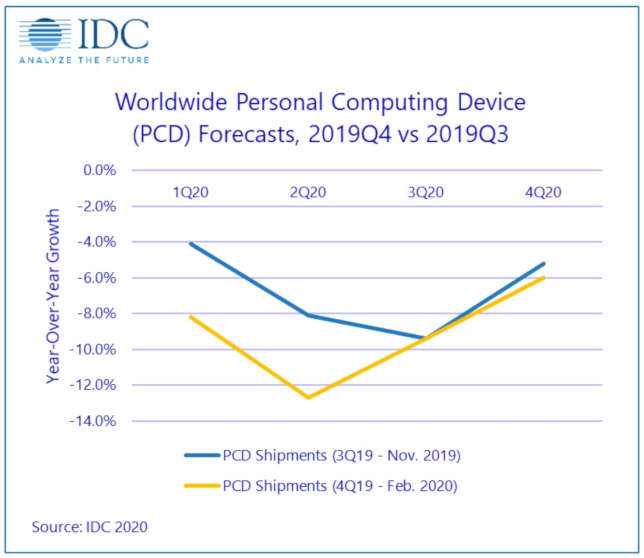
Meanwhile on the personal computing front, desktops, notebooks,
workstations and tablets will take a similarly large hit. In the
first quarter, personal computing devices are expected to decline 8.2
percent. That decline will increase to 12.7 percent in the second
quarter as existing supplies are depleted and the impact of
coronavirus on the supply chain is felt more acutely. IDC is
currently predicting that the impact will be less severe in the
second half of the year, though the market will still be in a
decline.
"There's no doubt that 2020 will remain challenged as
manufacturing levels are at an all-time low and even the products
that are ready to ship face issues with logistics," added Jitesh
Ubrani research manager for IDC's Worldwide Mobile Device Trackers,
in a prepared statement. "Lost wages associated with factory
shutdowns and the overall reduction in quality of life will further
the decline in the second half of the year as demand will be
negatively impacted."
According to IDC: “Assuming the spread of the virus subsides in
2020, IDC anticipates minor growth in 2021 as the market returns to
normal with growth stemming from modern form factors such as thin and
light notebooks, detachable tablets, and convertible laptops. Many
commercial organizations are expected to refresh their devices and
move towards these modern form factors in an effort to attract and
retain a younger workforce. Meanwhile, consumer demand in gaming as
well as the rise in cellular-enabled PCs and tablets will also help
provide a marginal uplift.”