Ruggedized Toughbook Tablets Get Faster Chips, Increased Storage
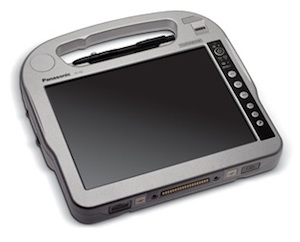
 The Panasonic H2 ruggedized tablet PC offers a 2.8 GHz Intel Core i5-3427U CPU and 500 GB internal storage.
The Panasonic Toughbook H2 ruggedized tablet PC offers a 2.8 GHz Intel Core i5-3427U CPU and 500 GB internal storage.

Panasonic has upgraded its line of ruggedized tablet PCs, the Toughbook H2. The new model gets improved CPU performance and beefed-up storage specs.

The 10.1-inch, XGA-resolution Toughbook H2, which is MIL-STD-810G- and IP65-certified and designed to survive a 6-foot fall, now features an Intel Core i5-3427U processor, with speeds up to 2.8 GHz. It also comes equipped with an internal, heated, shock-mounted, 7,200 RPM, 500 GB hard drive (or optional 128 GB solid state drive). Battery life has also been improved in the new model, with dual, hot-swappable batteries that offer up to seven hours of "uninterrupted work," according to Panasonic.

In addition to improved core specs, the new H2 also offers improved communications technologies, including Intel Advanced-N 6235 802.11 a/b/g/n wireless and Bluetooth 4.0+EDR standard. 4G LTE and Gobi mobile broadband are optional.

Other features include:

  • Sealed, fanless design certified for protection from rain, vibration, dust, shock, sand, altitude, freezing/thawing, temperature shock, humidity, and "explosive atmosphere";
  • Integrated handle;
  • Touchscreen and stylus;
  • "TransflectivePlus" display technology, which includes an adjustable LED backlight (1 nit to 500 nits) and a reflective layer that can produce up to 6,000 nits in daylight;
  • Strap with dome hand support for using the device while standing up; and
  • Various accessibility features, including touchscreen and wheelchair mount;
  • Optional security features, such as fingerprint scanner, Kensington lock slot, Computrace, and others.

The Toughbook H2 weighs in at 3.5 pounds and measures 10.8" (l) x 10.6" (w) x 2.3" (h).

The Panasonic Toughbook H2 is available now starting at $3,349 with a three-year warranty. It ships with Windows 7 Professional 32- or 64-bit. Additional details can be found on the Toughbook H2 product page.

About the Author

David Nagel is the former editorial director of 1105 Media's Education Group and editor-in-chief of THE Journal, STEAM Universe, and Spaces4Learning. A 30-year publishing veteran, Nagel has led or contributed to dozens of technology, art, marketing, media, and business publications.

He can be reached at [email protected]. You can also connect with him on LinkedIn at https://www.linkedin.com/in/davidrnagel/ .


Featured

  • Neon blue security locks with a single red highlight

    With AI, Cybersecurity Focus Shifts from Finding Flaws to Fixing Them

    For decades, one of cybersecurity's biggest challenges has been finding vulnerabilities before attackers do. A growing number of security professionals now say artificial intelligence is changing that equation, shifting the focus from discovering flaws to fixing them quickly enough to prevent exploitation.

  • Engineering team implements digital guardrails on AI

    3 Starting Points for Integrating AI Guardrails in K-12 Districts

    As education leaders start to craft an AI policy that is both practical and flexible enough to evolve with this fast-changing technology, there is at least one principle that should be foundational: AI should serve to augment human critical thinking and creativity but never replace human interaction and decision-making.

  • interconnected blue glass cubes

    Anthropic Expands Enterprise Deployment Options for Claude Desktop

    Anthropic is introducing new enterprise deployment options for Claude Desktop, saying organizations that use the app through Amazon Web Services, Google Cloud, and Microsoft Foundry can now access the full desktop experience across chat, Claude Cowork, and Claude Code.

  • Top View Shot in Elementary School Computer Science Classroom

    Education's Top 5 Technology Priorities and the Challenges Standing in the Way

    Cybersecurity ranks as the No. 1 priority for education technology leaders in the United States, according to the latest State of Ed Tech report from CoSN, yet insufficient cybersecurity staffing and the lack of a dedicated budget are key barriers.